About ALSA Auckland
Building a profession ready for the future.
ALSA Auckland exists because the legal profession needs lawyers who are confident, competent, and culturally fluent. We are building the structures that produce them.
ALSA Auckland exists because the legal profession needs lawyers who are confident, competent, and culturally fluent. We are building the structures that produce them.
The same pattern keeps emerging. New Zealand is one of the most diverse countries in the world. Auckland is one of the most diverse cities. And yet the further up the legal profession you look, the less that diversity is reflected. The pipeline narrows at every stage. It is a structural outcome that accumulates over years, and one the profession itself has begun to name. ALSA was built to address it from the student end.
What capable students are missing is rarely ability. It is infrastructure: visible pathways into the profession, mentors who have walked the same road, and a community where their background is a professional asset rather than something to manage around. A place to stand in the same rooms as anyone else, not despite who they are but because of it.
ALSA was built to provide exactly that. It is an independent incorporated society, not a cultural club: a professional platform, structured and credible, anchored in the skills and relationships that turn capability into career.
"The lawyers we are building relationships with today are the colleagues, the mentors, and the advocates we will rely on for the rest of our careers."
Jayden Lin, Founding President
ALSA did not arrive fully formed. It was built by a team who committed to the vision before there was anything to show for it, from a standing start: no university funding, no club room, no inherited membership. Every member, sponsor, and speaker was earned.

ALSA started in December 2025 with a single observation. For all the communities Asian students had built at law school, none were aimed at the hardest part: the transition into the profession itself. The more Jayden looked, the clearer it became that what held capable students back was not ability. It was visibility and access, the simple fact of not being seen by the people who shape legal careers. ALSA was built to close that gap.
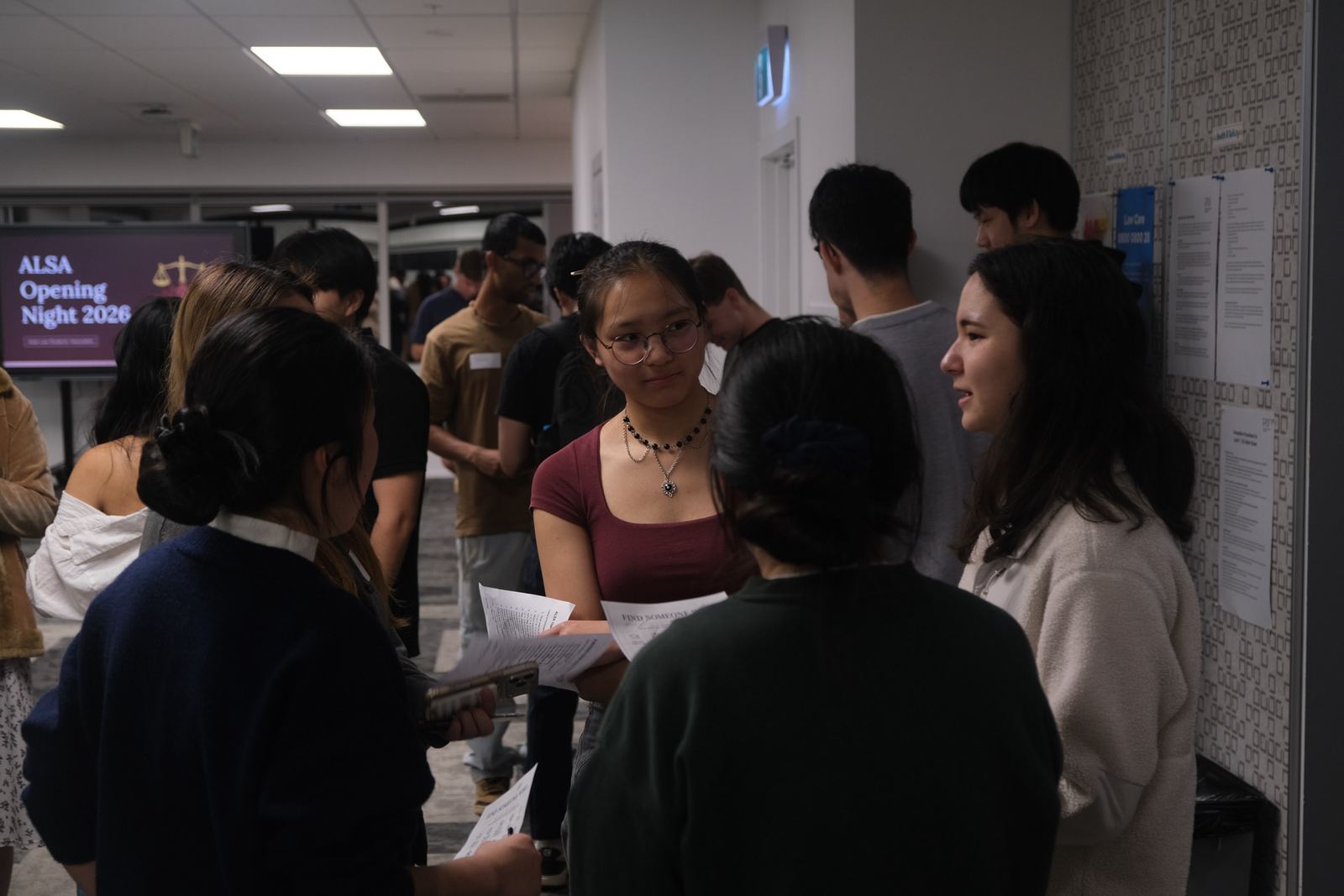
It moved quickly. Within months ALSA had a constitution, a full executive team, and incorporation as a society. It grew a strong membership base and secured sponsorships with established brands, including Anytime Fitness. In April 2026 it held its Inaugural Launch Event, headlined by Mai Chen, President of NZ Asian Lawyers. None of it existed a year before.

Gabriel was there before ALSA had infrastructure, members, or certainty. He led the operational delivery of the Inaugural Launch Night and managed the internal team through the early stages of formation.

Anthony handled the foundational work that made ALSA a real institution. He set up the bank account, managed the incorporation process, and built the financial infrastructure the organisation runs on.
ALSA's founding is grounded in evidence, not anecdote. The research on Asian communities in Aotearoa's legal system is clear: the gap between representation at entry level and representation in senior positions is real, persistent, and structural.
The Law Society's Snapshot of the Profession 2025 records Asian lawyers at 12.7% of the profession as at 30 June 2025, against 17.3% of the New Zealand population at the 2023 Census. The Law Society expresses this as one Asian lawyer for every 642 Asian people. In the cohort within seven years of admission the picture reverses: Chinese lawyers are 7.1% of that group against 4.6% of the profession overall, Indian 5.4% against 3.4%, Other Asian 4.6% against 2.9%, Southeast Asian 3.2% against 1.8%. Asian students are entering law in numbers. What the Law Society does not publish is any breakdown of ethnicity beyond the seven year mark, so there is no public figure for how many partners, barristers sole, King's Counsel or judges are Asian. Nobody can currently say what happens to that entering cohort. The absence of the number is itself the finding.
Source: NZ Law Society, Snapshot of the Profession 2025 →Mai Chen's 2019 report for the Superdiversity Institute, Culturally and Linguistically Diverse Parties in the Courts: A Chinese Case Study, was the first major New Zealand study of the barriers facing culturally and linguistically diverse parties in the courts. It drew on interviews with senior court judges, practitioners, prosecutors and interpreters, and a review of more than 100 cases involving parties of Asian ethnicity since 2000. It made 36 recommendations, covering interpreter certification, training and pay, duty interpreters, translated court information and signage, the treatment of culturally diverse witnesses and jurors, better data collection, and growing the cultural capability of the profession. The Supreme Court has since given guidance on evidence in cases involving culturally and linguistically diverse parties in Deng v Zheng [2022] NZSC 76. Competence here is not a soft skill. It is a condition on which equal access to justice depends.
Source: Mai Chen, CALD Parties in the Courts: A Chinese Case Study →In November 2023 NZ Asian Lawyers and the Law Society's Auckland branch ran an oversubscribed seminar on Asian parties in court and working with Asian clients, with around 125 lawyers present and more attending online. The Chief Justice presided over the panel session. The seminar drew on a stocktake of NZ Asian Lawyers' own members, which had gathered 127 responses covering twenty Asian ethnicities and twenty five languages. Respondents described discrimination, mostly in the form of unconscious bias, in professional and workplace social settings, with bias toward ethnic women reported as "institutionalised racism amongst colleagues and clients." Asked about unconscious bias, the Chief Justice accepted that decision making carries that risk and set out three responses: judicial education, a judiciary drawn from a wider range of backgrounds, and counsel putting the evidence and argument that force easy assumptions to be tested. She told the seminar that the success of Asian lawyers in the profession was not optional, and that on the demographics the profession's future would depend largely on them. She raised mentoring, including reverse mentoring, as a way of building routes into the senior profession and the judiciary. That conversation is being led by practitioners and judges, about a generation that is not yet in practice. ALSA works at the stage before it.
Source: NZ Law Society, LawTalk Issue 956, "You are seen. You are heard!" →"Lawyers need to have not just IQ and EQ; they have got to build their cultural capability of CQ, which is the ability to deal with people who are not like them."
Mai Chen, President of NZ Asian LawyersALSA Auckland is built to last and to grow. Over time, we want to explore with Asian law student organisations at other New Zealand universities whether a national layer could support shared resources, speaker relationships, standards, and a professional community that extends beyond any single university.
The longer-term ambition is to establish New Zealand as a national chapter of ALSA International. That connection would open direct pathways for New Zealand's Asian law students: international competitions held across Asia, exposure to how law is practised in different Asian jurisdictions, direct engagement with Asian law firms operating internationally, and the kind of cross-border relationships that are increasingly relevant in a legal market becoming more globally connected every year.
New Zealand's legal profession has an opportunity to be genuinely fluent in the legal and commercial cultures of its largest trading partners and fastest-growing communities. ALSA is building the students who will make that possible for the next generation.
ALSA runs five structured programmes covering academic skills, professional development, mentoring, student engagement, and marketing.
View Our Programmes